The grants, worth 850 euros each, correspond to the 2025-2026 academic year and bring the total number of grants awarded in its 33 editions to 844, with a total amount exceeding one million euros.
The Joaquín Torres Foundation has reached 844 scholarships awarded since its creation in 1992 after granting 24 scholarships to university students from Mequinenza for the 2025-2026 academic year. The call for applications, which had a budget of 20.400 euros, also coincides with the 35th anniversary of Torres' death, whose donation made the creation of the foundation possible and which, more than three decades later, continues to support the university education of young people in the town.
Each of the 24 scholarship recipients in this round receives 850 euros, the same amount as last year. These grants are compatible with other scholarships and are intended to help cover the costs associated with university studies. With this round, the Foundation has now awarded 844 scholarships, exceeding one million euros allocated for this purpose.
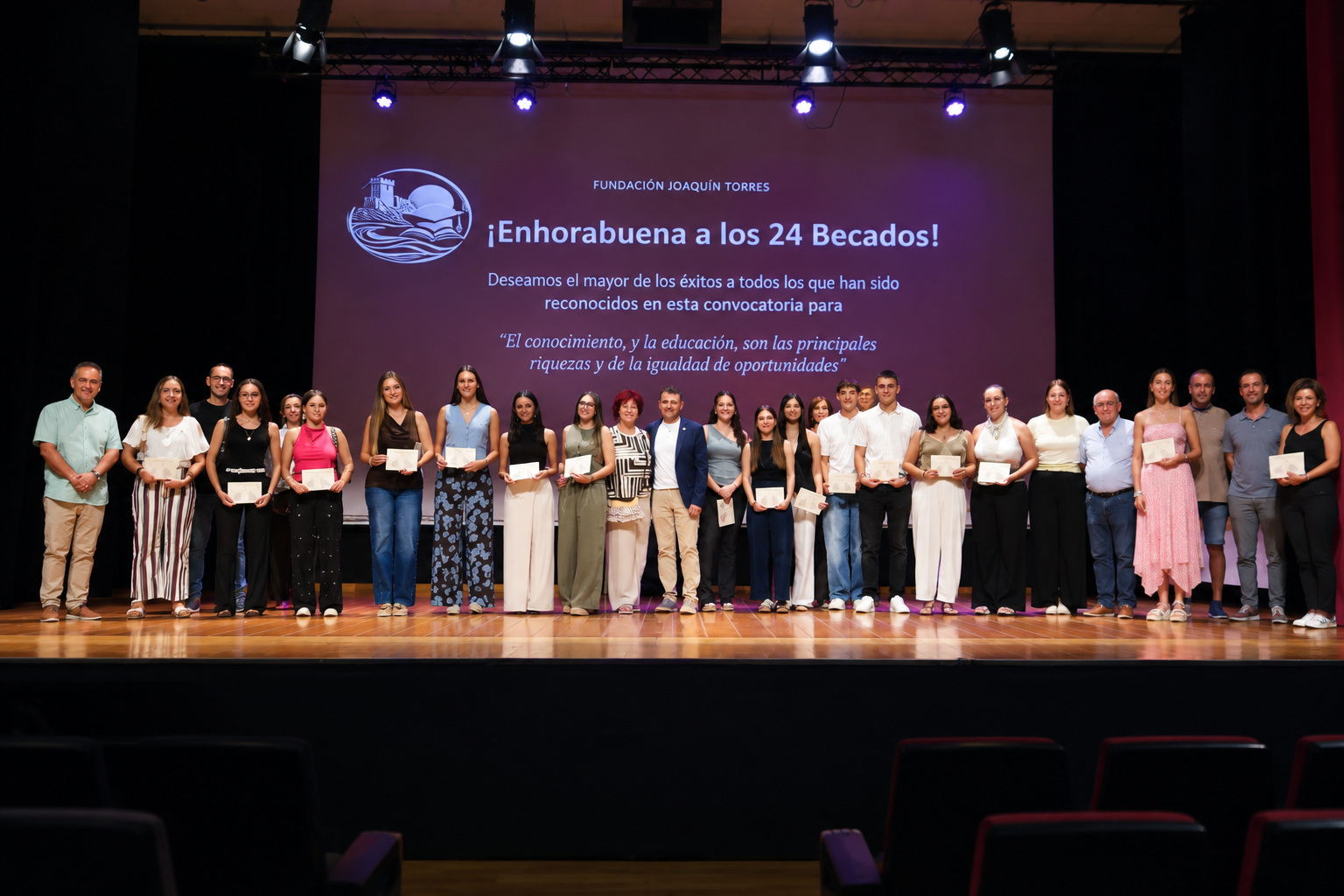
The 33rd Joaquín Torres Foundation Scholarships received 25 applications, 24 of which met the established requirements. The awards ceremony was held in the Goya Room in Mequinenza, bringing together the scholarship recipients, their families, and representatives of the Foundation.
This anniversary has allowed us to especially highlight during the event the figure of Joaquín Torres, a native of Mequinenza who made his fortune in Latin America in the publishing field and who decided to dedicate part of his wealth to supporting the education of young people in his hometown.
The president of the Joaquín Torres Foundation and mayor of Mequinenza, Antonio Sanjuán, has pointed out that these scholarships “are already part of the recent history of Mequinenza” and has highlighted that their continuity for more than three decades demonstrates that “good decisions can have positive consequences for many years.”
Sanjuán championed Joaquín Torres' legacy, emphasizing that he "left behind not only financial resources," but also "an opportunity to study, to train, and to face the future with greater possibilities." He further stressed that "the most beautiful thing is that the decision he made so many years ago continues to bear fruit today. You are proof of that."
The student beneficiaries also expressed their gratitude to their families for their support and effort throughout their university career, as well as to the Foundation for maintaining this aid and to Joaquín Torres for making its creation possible.
The 24 scholarship recipients are studying at ten different universities, although there is a significant concentration in universities near Mequinenza. 75% are studying at Catalan universities.
The University of Lleida (UdL), with six students, has the highest number of beneficiaries, followed by the Rovira i Virgili University (URV), with five. The University of Zaragoza (UNIZAR) and the Polytechnic University of Catalonia (UPC) each have three students, while two others are studying at the University of Barcelona (UB). The remaining five students are studying, one at each of the Autonomous University of Barcelona (UAB), the University of Valencia (UV), the Complutense University of Madrid (UCM), Pompeu Fabra University (UPF), and the University of Alicante (UA).
By field of study, engineering has the largest presence, with six students, representing 25% of the total. Within specific degree programs, Chemical Engineering, with three students, is the most represented. Other fields of study among the scholarship recipients include Mechanical Engineering, Early Childhood and Primary Education, Law, Labor Relations and Human Resources, Journalism, Archaeology, Chemistry, Nursing, Architecture, Marketing, Medicine, Social Work, Pharmacy, Nutrition, and English Studies, among others.
The event also served to convey to the young people the commitment to keep alive the spirit of Joaquín Torres's legacy, which remains linked to the future of Mequinenza. Sanjuán encouraged the scholarship recipients to take advantage of the opportunity these grants represent and, when the time comes, to assume the responsibility of contributing to future generations. "We all receive a torch from others at some point. And we all have, when the time comes, the responsibility to pass it on to those who come after us," he stated.
He also expressed his gratitude for the hard work of the members of the Foundation's Board of Trustees, "with whom I have shared the last six years, and with whom we have gone through what was probably the most difficult situation the Foundation has ever faced, one that threatened its continuity, and now we are experiencing a very different situation that guarantees its future." He especially wanted to acknowledge María José Fornos and Víctor Esteve, thanking them for their dedication and commitment.
This year's call for applications thus takes on a special significance as it coincides with the 35th anniversary of the death of Joaquín Torres, whose legacy remains alive through a Foundation that has already granted 844 aid and allocated more than one million euros to the university education of young people from Mequinenza.
Joaquín Torres Arbiol
Joaquín Torres Arbiol is the most notable and generous overseas emigrant from Mequinenza. He was born in Poble Vell, the old town center that disappeared due to the construction of the Riba-roja reservoir, on June 8, 1901, and died in Buenos Aires on August 10, 1991.
This philanthropic man from Mequinenza left his hometown at the age of 21 to do his military service in Madrid. There, as a result of a series of coincidences, he ended up working at the publishing house Espasa, the future powerful Espasa Calpe.
His performance at the company must have been so important that shortly afterwards, in 1926, the publishing house sent him to Buenos Aires to create a branch or delegation in the capital of Argentina.
He also combined his work as a salesman for other Spanish publishers such as Seix Barral and Cervantes. He dedicated himself to detecting clandestine and fraudulent editions, especially those coming from Chile, and warned publishers and bookstores to prevent their acquisition, thus fighting piracy. In 1931, he became the owner of the publishing house Juventud Argentina.